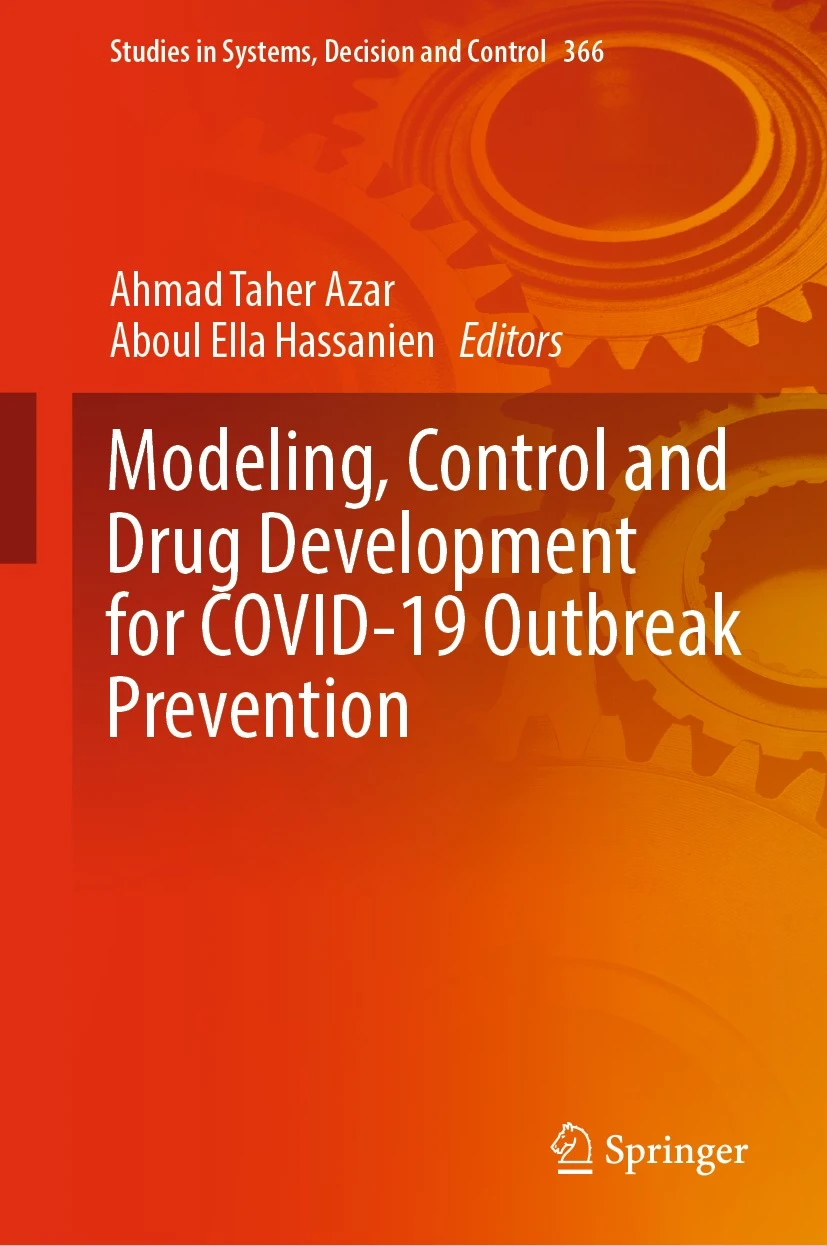
Book: Modeling, Control and Drug Development for COVID-19 Outbreak Prevention
Ensemble learning models coupled with urban mobility information applied to predict COVID-19 incidence cases
COVID-19
Ensemble learning
Urban mobility information
Artificial intelligence
Abstract
The coronavirus disease (COVID-19), according to the World Health Organization, by September 4th, 2020, has infected more than 26 million people, and more than 865 thousand have died from it in the worldwide. It is important to forecast the incidence of cases in a short-term horizon to help the public health system develop strategic planning to deal with the COVID-19. In this chapter, several artificial intelligence (AI) models including extreme gradient boosting, extreme learning machine, long short-term memory, and support vector regression are used stand-alone, and coupled with the ensemble empirical mode decomposition (EEMD) employed to decompose the time-series into several intrinsic mode functions and residual signals. All AI techniques are evaluated in the task of forecasting daily incidence COVID-19 cases in ten Brazilian states, with a high number of cases by September 4th, 2020, with seven and fourteen-days-ahead. Previous COVID-19 incidence cases and urban mobility information were employed as systems input for all forecasting models. The models’ effectiveness are evaluated based on the performance criteria. In general, the EEMD approach outperformed the compared models regarding the accuracy in 65% of the cases. Regarding the exogenous variables, urban mobility information indeed plays a key role in the forecasting task. Therefore, due to the efficiency of evaluated forecasting models to forecasting cumulative COVID-19 cases up to fourteen-days-ahead, the adopted models can be recommended as promising models for forecasting and can be used to assist in development of public policies to mitigate the effects of COVID-19 outbreak.
NoteHow to cite this work
Ribeiro, Matheus Henrique Dal Molin, Ramon Gomes da Silva, José Henrique Kleinübing Larcher, Viviana Cocco Mariani, and Leandro Santos Coelho. 2021. “Ensemble Learning Models Coupled with Urban Mobility Information Applied to Predict COVID-19 Incidence Cases.” In Modeling, Control and Drug Development for COVID-19 Outbreak Prevention, edited by Ahmad Taher Azar and Aboul Ella Hassanien. Springer International Publishing. https://doi.org/10.1007/978-3-030-72834-2_24.
@incollection{ribeiro2021springer,
 address = {Heidelberg, Germany},
 author = {Matheus Henrique Dal Molin Ribeiro and Ramon Gomes da Silva and José Henrique Kleinübing Larcher and Viviana Cocco Mariani and Leandro Santos Coelho},
 booktitle = {Modeling, Control and Drug Development for COVID-19 Outbreak Prevention},
 edition = {1},
 editor = {Azar, Ahmad Taher and Hassanien, Aboul Ella},
 month = {Jan},
 pages = {690},
 publisher = {Springer International Publishing},
 title = {Ensemble learning models coupled with urban mobility information applied to predict COVID-19 incidence cases},
 volume = {366},
 year = {2021}
}